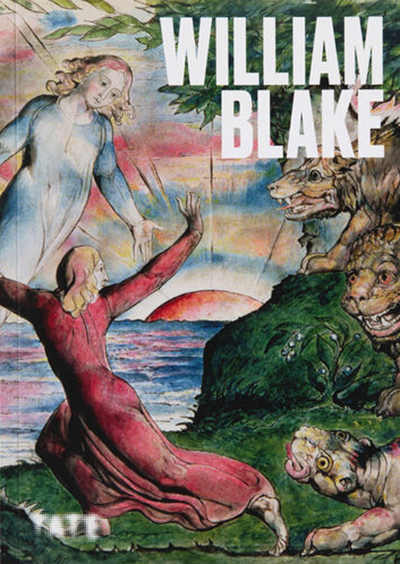
Offering “a beginner’s guide to the world of William Blake” (5) with an emphasis on his pictorial and graphic productions, Caroline Anjali Ritchie’s slim volume is part of Tate Publishing’s Artists Series. As with the other publications in this series, the book is pitched at a general audience and, as such, follows recent, longer endeavors to present Blake’s life and influence through his creative works, most notably Jason Whittaker’s Divine Images: The Life and Work of William Blake (2021; see Matthew Leporati’s review in Blake, vol. 58, no. 4, https://doi.org/10.47761/biq.382). Unlike Whittaker, Ritchie has the unenviable task of condensing Blake’s life, work, relationships, and legacy to fit the format of a series that dedicates much of its page count to color reproductions of visual works. Her previous experience as an assistant curator at Tate Britain informs this publication, which in just twenty pages provides a succinct biographical account and brief discussions of major (and some minor) works, with occasional nods to reception in the twentieth and early twenty-first centuries.
Ritchie presents Blake’s life chronologically, following the different stages of his career, from his early life and attendance at Henry Pars’s drawing school on the Strand to his apprenticeship under James Basire, his commercial work for Joseph Johnson during the 1780s–90s, his time in Felpham and relationship with Hayley, his 1809 one-man exhibition, and his later years with Linnell and the Ancients. These biographical events are, at times, punctuated with discussion of specific works that convey a sense of Blake’s creative activities across a range of media, from commercial reproductive engravings and experimental relief-etching and printing techniques to original graphic and pictorial design. Some of these discussions draw connections between his commercial work and his subsequent pictorial art, such as the compositional influence of the engraving “Fertilization of Egypt” (1791) after Henry Fuseli on The Great Red Dragon and the Woman Clothed with the Sun (c. 1803–05). Ritchie also has a parenthetical aside noting the appearance of Blake’s watercolor in “Brett Ratner’s 2002 film Red Dragon” (although there is no mention of Thomas Harris’s novel on which the film is based) and sprinkles in other examples of Blake’s influence on contemporary culture, including horror movies and video games.
Given that this is a beginner’s guide, Ritchie commendably mentions several of Blake’s lesser-known works, such as Tiriel (15) and the watercolor illustrations to Gray (18). There is also a longer discussion of his engravings for J. G. Stedman’s Narrative, of a Five Years’ Expedition, against the Revolted Negroes of Surinam. Some of these images depict, as she observes, “acts of extreme violence” (12). Illustrating the relationship between Blake’s commercial work and his illuminated books, Ritchie briefly rehearses the connection between the Stedman plates and Visions of the Daughters of Albion (1793). While Stedman’s Narrative was published in 1796, Blake appears to have been working on some of the engravings from around 1791. Acknowledging that more work needs to be done to understand how these engravings relate “to the realities of the slave trade or the abolitionist cause in Britain,” Ritchie also observes that “Blake tends to Europeanise the people of colour” (12). At this point it would be helpful if she explicitly stated that Blake etched and engraved the plates but didn’t design them. The “80 elegant Engravings” in the Narrative are based on “drawings made by the Author.”Quoted from the title page of the Narrative. All but one of these drawings are untraced.The one Stedman drawing that has so far been identified is a watercolor that was engraved as “Manner of Sleeping &c. in the Forest” by Inigo Barlow. See Robert N. Essick, William Blake’s Commercial Book Illustrations, Clarendon Press, 1991, XXXIII. While it is conceivable that Blake altered aspects of Stedman’s originals, it is not currently possible to know the extent of any changes (or if alterations were made) without the drawings to compare to the engravings.
With so little space to work with because of the format of the series, it is inevitable that certain areas of Blake’s life, work, and relationships are glossed over with one or two sentences, while other events are given more attention. In the case of Blake’s interactions with Robert Hartley Cromek, Ritchie takes time to explain this fraught relationship and shows how it informed his 1809 exhibition and the defense of his theory and practice of art as set out in the Descriptive Catalogue. She also dedicates several paragraphs to Thomas Butts, who was a crucial patron between 1799 and 1810, providing a creative outlet and a steady if small income. Butts collected a range of Blake’s work: illuminated books, color-printed drawings, and many paintings, including illustrations to Milton’s poetry and the Bible. Ritchie intriguingly suggests that the “series of over 100 impressive watercolours on biblical subjects” that Blake executed for Butts during the first decade of the nineteenth century “may have been intended for insertion into a printed Bible” (20). In a letter to Butts of 10 January 1803, Blake relates the desire that his art “should be preservd in your Green House.”The Complete Poetry and Prose of William Blake, edited by David V. Erdman, newly rev. ed., Vintage, 1988 [abbreviated as E] 724. The “Green House” was Butts’s residence in Dalston, northeast London (now part of the borough of Hackney). Ritchie’s suggestion prompts several questions about Butts’s attitude to the pictorial works he purchased from Blake and Blake’s own awareness of how his paintings were treated once they left the “stocks.”Blake to Butts, 6 July 1803 (E 729). How, for instance, were the biblical watercolors “preservd” in Butts’s Green House?See also Joseph Viscomi, “A ‘Green House’ for Butts? New Information on Thomas Butts, His Residences, and Family,” Blake, vol. 30, no. 1, summer 1996, bq.blakearchive.org/30.1.viscomi. Were they used to create an extra-illustrated, elephant folio Bible, kept in large portfolios, or even hung on the walls?Blake executed over 135 biblical tempera and watercolor paintings for Butts between 1799 and 1809. For the temperas, see Martin Butlin, The Paintings and Drawings of William Blake, vol. 1, Yale UP, 1981, #379-432; for the watercolors, see Butlin #433-526.
The illustrations accompanying Ritchie’s biographical account of Blake take up most of the book and present the range of his graphic and pictorial work, as well as select pages from the illuminated books. Because of the format, at first glance the reproductions distort the scale of Blake’s originals, so that, for instance, his largest engraved copperplate, “Chaucers Canterbury Pilgrims” (1810), appears of a similar size to the woodcuts for Thornton’s The Pastorals of Virgil (1821). The inclusion of measurements for the originals goes some way toward addressing this issue. It should be noted that there are a couple of factual infelicities concerning biographical information and the dating of certain works.Poetical Sketches was published in 1783, not 1777 (15). The Blakes rented their Felpham cottage from the landlord of the Fox Inn, George Grinder, not William Hayley (18); for Grinder, see G. E. Bentley, Jr., Blake Records, 2nd ed., Yale UP, 2004, pp. 158-59. James Parker is described as Blake’s “fellow Royal Academy student” (10), yet there is no mention that Parker was Blake’s fellow apprentice under Basire (Parker became an apprentice in August 1773, twelve months after Blake). Also, as this is a guide that emphasizes Blake’s graphic and pictorial works (many of which are in Tate Britain), there is little to no discussion of important manuscripts such as An Island in the Moon (1784–85) and Vala, or The Four Zoas (1796–1807). Nevertheless, there is much to admire in this condensed account of Blake’s life and work. For instance, Ritchie follows recent scholarship on Catherine Blake by dedicating several paragraphs to outlining her role as an artist, printer, salesperson, and “custodian of William’s art following his death,” as well as drawing attention to her reception in works such as Sasha Dugdale’s award-winning poem “Joy” (14). By artfully connecting Blake and Catherine to contemporary forms of cultural expression, from literature and sculpture to modern cinema and video games, Ritchie ensures that this guide engages with a broad readership.