Blake’s Notebook (19.6 x 15.7 cm.), sometimes known as the Rossetti Manuscript, consists of 116 pages of autograph drafts of poems, prose fragments, and epigrams, plus over 80 sketches, designs, and picture emblems in a combination of pencil and ink and wash. Robert Blake, the original owner, made a few sketches in ink and wash; the text and all other images, produced after Robert’s death in 1787, are by William. The final work in the Notebook, the unfinished Everlasting Gospel, was composed around 1818.Dante Gabriel Rossetti added a partial and unreliable transcript of some of Blake’s poems when he had the Notebook bound in half calf.
Although Dante Gabriel Rossetti acquired the Notebook in April 1847 for ten shillings, the first mention in his surviving correspondence does not occur until July 1851, when his fellow poet William Allingham is instructed not to make use of “any of those extracts which you took from my book at the time I lent them to you.”Dante Gabriel Rossetti to William Allingham, Monday [July 1851], in D. G. Rossetti 173. For further details, see W. M. Rossetti 1: 302-03 and Dorfman 59-64, 80-82, 102-06, 134-46. Rossetti’s acquisition is noted in his comments on the flyleaf: “I purchased this original M. S. of Palmer, an attendant in the Antique Gallery at the British Museum on the 30th April 1847.… Among the sketches there are one or two profiles of Blake himself. D. G. C. R.”D. G. Rossetti 174. Palmer was the brother of Samuel Palmer, the most distinguished member of the Ancients.
The significance of Blake’s Notebook is universally recognized, yet the last major scholarly intervention took place in 1977, in the form of David V. Erdman’s revised edition of the facsimile entitled The Notebook of William Blake, which superseded an earlier collotype facsimile by Geoffrey Keynes. Erdman’s variorum edition combined systematic commentary on Blake’s texts and images, a mixture of infrared photography and high-contrast prints, and a typographical facsimile of each page. One of Erdman’s many critical accomplishments was to highlight how the emblems in the Notebook form a matrix from which Blake developed the imagery in The Gates of Paradise and Songs of Experience.
As implied above, Erdman supplied his reader with a clear impression of the layout, physical appearance, and conceptual organization of Blake’s unusual production. Additionally, he kept an abundance of material under control and secured a sense of interrelation without reducing the Notebook to a one-dimensional object. All in all, he provided a commanding cross-disciplinary critical framework for understanding how Blake’s production became a launchpad for subsequent discussions of the subjectivity of the creative individual.
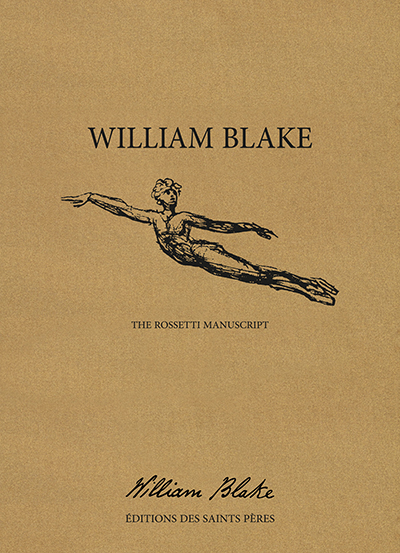
Since then, there have been some general comments on the Notebook, but not enough about how it became a catalyst for debating and recording the creativity of mental acts for members of the Rossetti circle and other significant reading communities.The Notebook, which provides an extraordinary insight into Blake’s working methods as artist and poet, is largely overlooked in contributions to Crosby and McQuail. If we want to understand the critical history of Blake’s Notebook—to know how it was used as a platform for discussing the alleged sequestration of art—it would be sensible to pay more attention to why it exercised a profound influence on Rossetti and his associates. Alas, one gets no real sense of how the Notebook operated as a form of cultural contact in William Blake: The Rossetti Manuscript, which is in essence a luxury object, produced on Fedrigoni Avorio paper by SP Books–Éditions des Saints Pères, a French publishing house specializing in high-end facsimile editions of famous works.The marketing people at Fedrigoni have an elevated view of their ability to harness creative mental activity: “A blank page is where ideas are conceived. Fedrigoni Special Papers are where they take shape. We make high-quality papers of every weight and colour that will transform your vision into something you can hold in your hand.” See specialpapers.fedrigoni.com/nam/about-us. This gilded edition in 35 x 25 cm. format belongs to a virtual library where it sits alongside Shelley’s Frankenstein, Wilde’s The Picture of Dorian Gray, Barrie’s Peter Pan, Gauguin’s Noa Noa, Orwell’s 1984, Capote’s In Cold Blood, and Woolf’s Mrs. Dalloway, plus a galaxy of other landmark literary, scientific, and political productions. These facsimiles are issued in limited editions of 1,000 copies and are priced accordingly. The target audience for this type of venture would appear to be the well-heeled bibliophile with a vested interest in sumptuous facsimiles of important manuscripts with handmade slipcases, which may explain the absence of anything resembling an apparatus criticus and the restriction of the short introduction, titled “Publisher’s Note,” to generic pronouncements on Blake, plus a few formulaic comments on the history of the Notebook.
There are several additional difficulties with this lavish but frustrating production. The uncredited introductory essay offers no comments on previous facsimiles and shows no interest in the many crucial editorial and hermeneutic issues highlighted by Erdman, who is missing from the very short bibliography.Erdman, ever alert to the communicative possibilities of Blake’s picture gallery of emblems, notes, “Any talk about the emblems requires a common denominator of validity, and I have tried to hold to readily verifiable or descriptive interpretations and to indicate patterns and salient motifs without closing doors” (Blake 15). There are problems with layout and organization. The introduction includes several misleading references about pagination in this facsimile. The illustrations lack the telluric and crystalline qualities of Erdman’s edition, which emphasized the raw plasticity of Blake’s forms and reproduced the boundaries of the Notebook. Some reproductions resemble rough transfers without a proper sense of tonal contrast; others are wispy, with insufficient surface definition and detail; still others fail to detect the faint lines and partly erased figures in the original designs, distort the figure-ground relationship, smudge and darken bodies, or transfer them into blurred, blotted, and bulky forms.See, by contrast, the reproductions of the following pages at The William Blake Archive: 4, 5, 7, 13, 17, 28, 29, 47, 52, 56, 70, and 77, blakearchive.org/copy/bb122.1?descId=bb122.1.ms.01. For instance, coarse lines eradicate the diaphanous quality of some of Blake’s bodies; fuzzy definition fails to replicate the liquidity of his designs; heavy forms cannot convey the vitality and movement of his drawings.
It should be noted that the pages in William Blake: The Rossetti Manuscript do not reproduce Blake’s workaday splodges, blotches, and glue spots with the same clarity as Erdman’s facsimile. Furthermore, the oversized format provides no sense of Blake’s day-to-day engagement with what was a pocketbook brimming with ideas about art, design, and poetry. At no point is the reader given an insight into how the Notebook should be categorized, classified, and contextualized; how it relates to the idea of the commonplace book; or how it was reimagined by Rossetti and his close friends, many of whom believed that Blake freed the modern artist from the specter of academicism by revealing that art was an extension of the normal conditions of living. In short, William Blake: The Rossetti Manuscript does not supply a meaningful apparatus of interpretation, includes reproductions of variable quality, and makes no attempt to bridge an existing historiographical divide by reconnecting the Notebook to formative reading communities.